
Oct 2026 ChessZCam: Studio first, Android next, Live last. Free 14-day Studio trial · 50% waitlist discount when sales open. Join the waitlist →

Recording guide · illustrated

Record it right once. Fix less later.

ChessZCam reads the moves from what the camera sees. These pictures show the setup that gives the best result — the same advice the app's own setup check gives. It takes about five minutes before round one.

0:1445°–90° downTallest far piecefully in the pictureAll four corners + a little marginSoft, even lightFirm stand beside the boardtaped or weighted,out of the players' reachweight / tape
The setup in one picture: a firm stand beside the board, the camera looking down at 45°–90°, the whole board and a margin in frame, soft light from above.

If you remember three things

Steady. Whole board. Clear view.

01

Steady

The same view from move 1 to the result. A stand that cannot be bumped is worth more than a better camera.

02

Whole board

Four corners and a margin in the picture, nothing cut off, the far pieces fully visible.

03

Clear view

Even light, sharp focus, and nothing resting over the board once a move is made.

Nine rules, in pictures

Do this — avoid that.

Green is what works; rose is what makes detection harder. Click nothing: each picture is self-explanatory.

Look downToo flat45°–90°pieces hide each otherEvery square stays visibleBack ranks disappear

1Look down at 45°–90°

Mount the camera beside the board, looking down at it. A steep view keeps every square visible; a low, flat view lets pieces hide the ones behind them.
Whole boardCorner cut offFour corners + margin;A corner outside the picturethe far king still in framecannot be locked

2Show the whole board

All four corners in the picture with a small margin, and the tallest piece on the far rank fully visible. A 0.5× (wide) lens often frames the board best.
Steady standBumped standtape / weightbump!Same view all gameThe picture moves: realign

3Keep the stand steady

Tape or weigh down the stand and keep it out of the players' reach. Small shifts can be realigned; a turned board or camera needs correcting by hand.
Even lightGlare & shadowwindowDiffuse light from above;Reflections and hard shadowsmatte pieces read besthide pieces on some squares

4Light it evenly

Diffuse light from above. Avoid lamps and windows reflecting on the board and hard shadows across it. Matte sets with clear contrast read best.
Set once, then leaveChanging mid-gameQualityBalanced 1080pFocusLockedExposureLockedLens0.5× if it fits bestZoomChanged mid-gameExposureSwings with lightLensSwitched mid-gameResolutionBelow 720pLock what the phone offersEach change moves the picture

5Set the camera once

Balanced 1080p (or Creator if you publish); lock focus and exposure if your phone offers it; keep the same lens and zoom all game.
Away from the boardAgainst the edgeLeave a clear marginMay look like pieces in play

6Captured pieces off the board

Place captured pieces well away from the board. Pieces standing against the edge can be mistaken for pieces still in play.
Hand passesArm stays over the boardHand inMoveClear viewposition hidden for a long timeAfter every move theposition is visible againVery fast exchanges may need review

7Give every move a clear moment

Hands may pass through the picture; what matters is that the new position becomes visible. Very fast exchanges and long obstructions may need a quick review.
Whole game, one fileEdited copies● Recmove 1result■ StopOriginal filestretchedLOGOlogo on squaresjump cutsStart position visible,Analyse the original,keep the originaledit afterwards

8One original file

Start before move 1 with the starting position visible, stop after the result, and analyse the original file. Crops, stretching, jump cuts or logos over squares make it harder — edit afterwards.
Power + spaceLow battery / fullpower bank≈ 4.5 GBper hour atBalanced 1080pLow batterymay stop mid-gameStorage fullstops the recordingCharger or power bankCheck both before round 1

9Power and storage

Bring a charger or power bank. Balanced 1080p needs about 4.5 GB per hour (Creator about 7.2 GB, Tournament 720p about 1.8 GB).

Built into the app

The setup check reads five things for you.

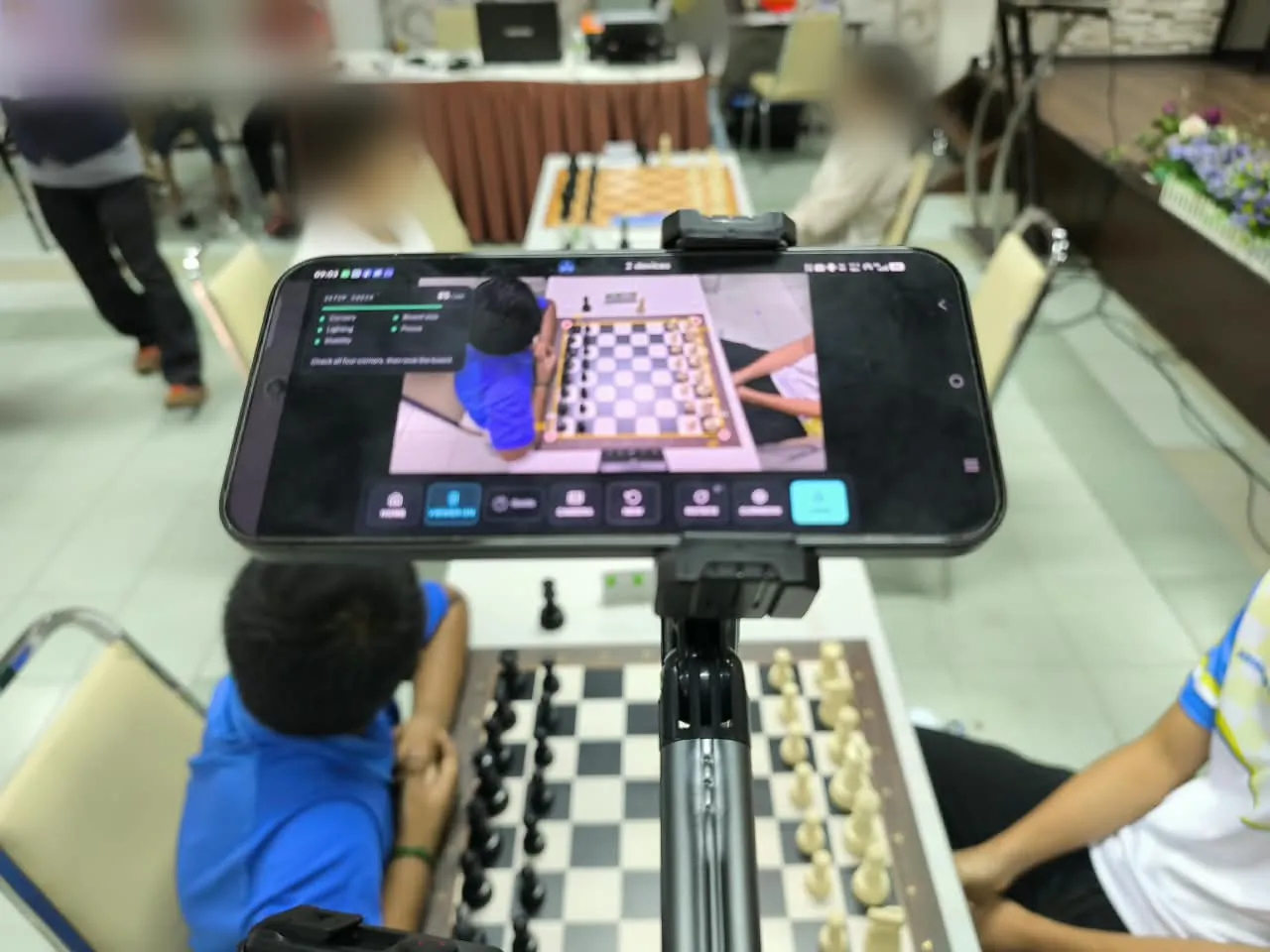
Before you lock the board, ChessZCam checks the picture and gives a plain hint for each reading — for example “Raise the camera or reduce the viewing angle”, “Add diffuse light” or “Keep the camera still and secure the stand or tripod”.
  • Corners — all four markers inside the picture, not crossed
  • Board size — the board fills enough of the frame
  • Lighting — enough contrast, no glare
  • Focus — piece edges look sharp
  • Stability — the camera is not moving
Camera phone on its stand at a tournament with the ChessZCam setup check panel; faces are blurred
At a real tournamentThe setup check on the camera phone before a round, 3 Oct 2026.
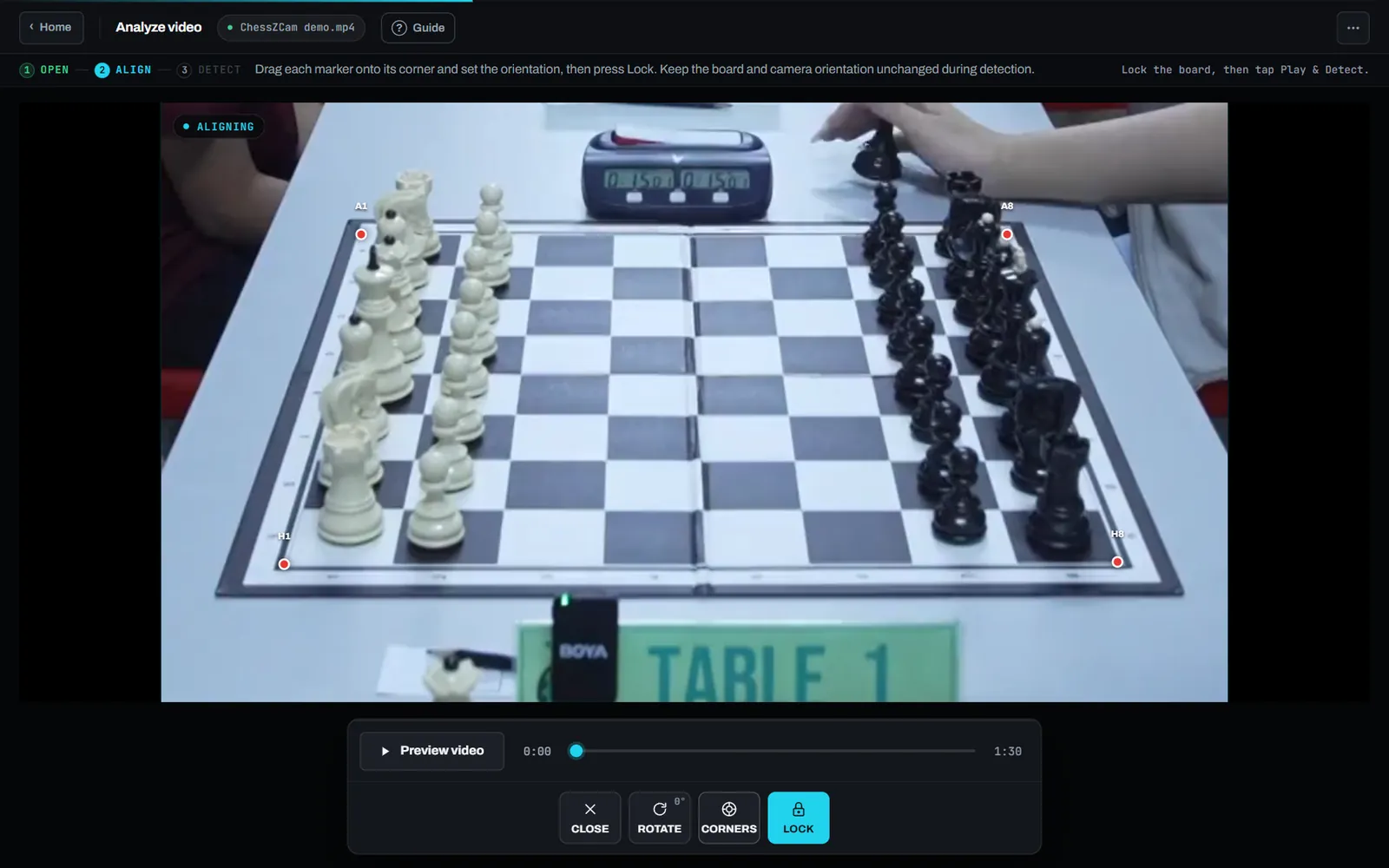
ChessZCam Analyze Video with four corner markers on the board corners of the demo clip, ready to lock
Then: Corners → LockThe four corners are found on the demo clip; tap Lock when every marker sits on its corner.

Settings

Recording quality, in numbers.

PresetVideoStorage per hourUse it for
Balanced1080pabout 4.5 GBRecommended for most games
Creator1080pabout 7.2 GBFootage you will publish
Efficient720pabout 2.7 GBSaving space
Tournament720pabout 1.8 GBLong games or low storage

Presets of the Record Game Video screen in the ChessZCam app. With ChessZCam Studio on Windows you can also use a webcam, a capture card or OBS Virtual Camera; Studio keeps the source's own aspect ratio. More resolution alone cannot fix a blurred or blocked view.

Before round one

The ten-point checklist.

  1. Stand firmTaped or weighted, out of the players' reach.
  2. Camera beside the boardLooking down at 45°–90°.
  3. Whole board in frameFour corners, a margin, the far king visible.
  4. Lens and zoom setFocus and exposure locked if available.
  5. Light checkedNo glare, no window or lamp reflection.
  6. Power and spaceCharger or power bank; about 5 GB free per hour.
  7. Captured-piece areaWell away from the board.
  8. Recording startedBefore move 1, starting position visible.
  9. Hands off the standDo not move the camera during the game.
  10. Stop after the resultKeep the original file for Analyze Video.

After the game

From recording to PGN and video.

01

Analyze Video

Open the recording, Corners → Lock, then Play & Detect or Adaptive.

02

Review

Check the flagged moves against their video frames; connect any gap with legal moves.

03

Export

Save the PGN, add Stockfish if you like, and render the overlay video.

See the whole workflow in motion →

FAQ

Recording questions.

Phone or camera — which is better?

Either works if the view is steady and the whole board is in frame. A phone on a stand is the simplest; a camera or capture card into ChessZCam Studio suits a fixed production setup.

Can I film straight from above?

Yes. Anything from 45° to 90° (straight down) works; steeper views hide fewer pieces.

Does 4K help?

Not on its own. A steady, sharp, evenly lit 1080p recording is better than a shaky or blurred 4K one.

What if someone bumps the stand?

Small shifts can be realigned: in Analyze Video use Tools → Realign board; in the live modes the board realigns itself after a small bump. A turned board or camera needs correcting by hand.

Can I use footage filmed for YouTube?

Yes, if it shows the whole board steadily. Analyse the original file rather than the edited video: crops, zooms, jump cuts and graphics over the board make detection harder.

Ready to try it

Bring a well-recorded game.

ChessZCam Studio comes first, with a free 14-day trial on one PC. Trial invitations go to the waitlist first; joining is free and is not an order.